
THE SPUM FILM · 60 SECONDS
See what runs here.
Local language models, image understanding and AfterGlow piano continuation. Explore recorded runs and biomedical instrument applications.
Five instruments, one engine.
Spum is built for purpose-built machines in biomedical work: optics on a floating table, a microscope stage, a handheld X-ray detector, a portable endoscope, a piano in a therapy room. Explore the instrument workflows and recorded engine runs below.
A Neuroscape Imaging product.
Optics on a floating table
Spum runs language and image models on the bench computer. Connecting inference to beam steering is a development direction.
- A language or image model served on the bench computer
- One model split across two of your own machines (Spum Link)
A microscope that can be asked
Read the field of view on the instrument and write the finding. Image reading runs today; a model that drives focus and stage moves does not yet.
$
Handheld X-ray reading
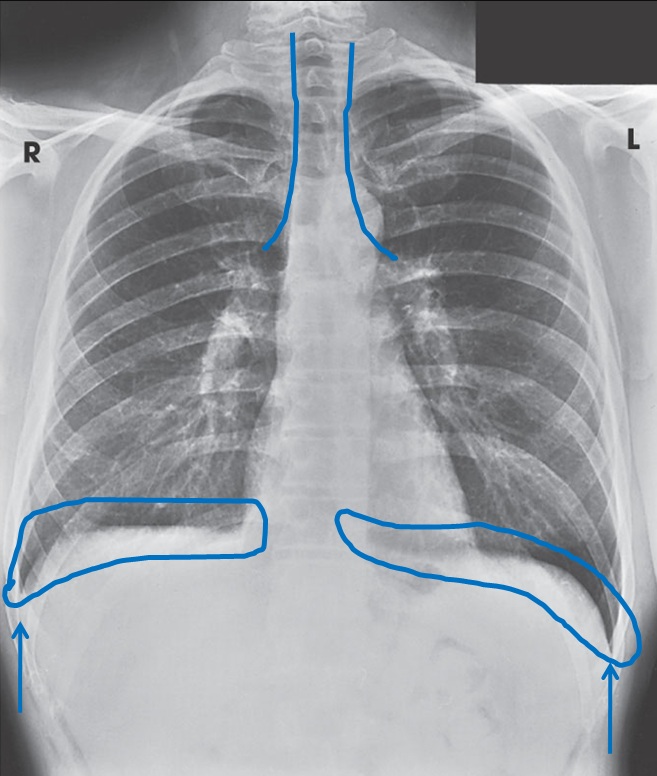
MedGemma can support local image description on the Mac. The terminal below records a real run on the downloadable teaching chest X-ray. Live interpretation on a handheld detector is the next step.

Label-free imaging with a portable endoscope
Contrast from the tissue itself, no dye, read by a model on the cart beside the patient. Spum currently reads still images; frame-by-frame integration is a development direction.
- Still images read by a vision-language model on the cart computer
Live brain imaging with lasers and EEG
Near-infrared laser light through the scalp; the decay of its speckle pattern gives cerebral blood flow in real time, with EEG alongside. Connecting both streams to on-device inference is a development direction.
- Language and image models on the bedside computer
AfterGlow: piano continuation
A pianist plays a phrase and the Aria model answers with the next bars, natively on the engine with no Python, for programs that use piano playing in PTSD therapy. The animation shows the continuation workflow.
$
Built on work at the bench.
Scientific Perception Uniting Mind & Matter grows from executed instrument software, optical research and biomedical product development.
Neuroscape · biomedical imaging
Portable endoscopy hardware and integrated acquisition, computational imaging and AI-assisted review, documented at TRL 5 with a Regency Hospital pilot.
Neuroscape Imaging →
Published foundation: multi-camera array microscopy (Optica, 2023), coauthored by Vinayak Pathak, includes large histopathology composites. These projects establish the research and engineering foundation. Spum provides the native inference engine; each project’s connection to that engine is described separately.
Sensitive work should not have to leave the laptop.
Patient images, process data, unreleased designs and contracts are the things people hesitate to paste into a cloud chat box. Spum runs the whole model on the machine in front of you, as fast as the hardware allows, so you do not have to choose between privacy and speed.
Images read where they were taken
A radiograph, a slide, a field of view: MedGemma reads it on the Mac it was captured on. Nothing is uploaded, because there is nowhere to upload to.
Heavy instrument data, summarised in place
Point it at a day of captures or logs and get totals, outliers and a written report computed from the raw files on your machine. This document tooling is in development; the engine underneath is available now.
No account, no upload, no network needed
After the model file is on disk, Spum runs offline. There is no telemetry endpoint to trust because there is nothing to send to.
Inside the engine.
An instrument cannot wait on a data centre. Spum starts with language and image models, because that is where the speed work is proven, and extends toward the control loops. This list is kept current.
- Language models on Apple silicon
- Llama, Qwen 2.5, Qwen 3.5, Gemma 4 and MedGemma 4B in GGUF, on the Metal GPU, through a local OpenAI-compatible server, at or above llama.cpp speed.
- Clinical images read on the machine
- MedGemma takes an image with the question. The image is encoded on the GPU and never leaves the computer.
- Speculative decoding
- Prompt lookup and the Gemma 4 drafter, with output identical to plain decoding. About 1.24 times Magnitude's speed on Gemma 4 in our runs.
- Spum Link
- Split one model across two of your own machines over an encrypted link. CPU engine today; no third-party servers, ever.
- AfterGlow piano continuation
- The Aria MIDI model running natively on the engine, no Python: 192 new tokens in 0.49 s on an M5 Max, native MIDI input and output. F16 reference parity was checked; Q8 differs in 2 of 192 greedy tokens.
- NVIDIA CUDA backend
- Llama, Qwen 2, 2.5 and 3, and MedGemma run on the CUDA backend. On an H200 it measured 1.5 to 1.75 times llama.cpp's prefill and 1.13 to 1.38 times its decode. Gemma 4 and image input are not on CUDA yet.
Every result goes on the ledger, including the ones we lose.
Measured on an Apple M5 Max and on an NVIDIA H200, with runs from each engine interleaved. On small Llama-class Q4_K_M models on the Mac, Spum is level with llama.cpp; on the H200 it is ahead on every row so far. Prompt of 256 tokens, 128 generated. The list grows as new models and engines are tested.
0 of 45 benchmarks recorded, 0 faster, 0 slower
Bars show Spum's speed as a multiple of the other engine; the line marks parity. Apple M5 Max rows were measured on 30 and 31 October 2026 in high-power mode. NVIDIA H200 rows were measured on 31 October 2026 on one idle GPU against llama.cpp's CUDA build 0ec4027, interleaved, five-round medians.
Perplexity on wikitext-2 matches llama.cpp to within about 0.2%, so the speed is not bought with accuracy.
Your models, images and chat in one local window.
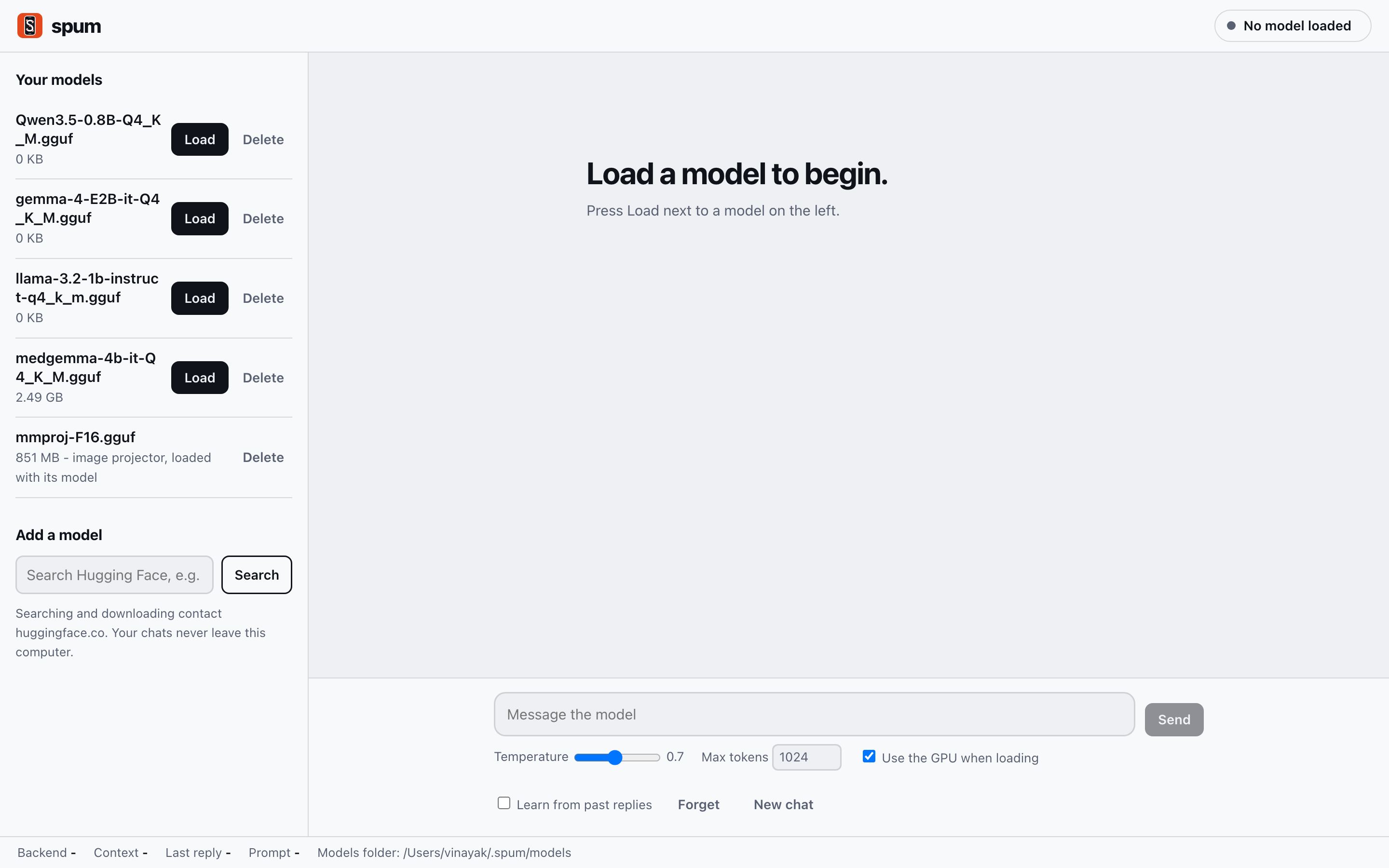
The Spum app keeps a library of models on your disk, finds and downloads new ones, switches between them without a restart, encodes an attached image while you are still typing, and shows live speed as you chat. It listens only on this computer and refuses requests from other web pages.
One binary. Start it and talk to it.
Spum serves the same API your tools already speak, so existing code and agents work without changes.
spum serve medgemma-4b-it-Q4_K_M.gguf --gpu --port 11436

curl localhost:11436/v1/chat/completions \
  -H "Content-Type: application/json" \
  -d '{"messages":[{"role":"user","content":"Summarise this capture log."}]}'
Builds are private while the macOS app is signed and notarised. Ask for access.
Spum is not a medical device. It is a research and engineering tool and must not be the sole basis for a clinical decision.